An Integrated Compliance-as-a-Service platform for EU DPP & ESG Reporting (Scope 3 Audit), and Circular Electronic Asset Health Test

Why Refurbished Devices Matter for ESG Goals?
Understanding the future of circular product compliance in Europe.
EU ESG Insights & Regulatory Briefing
SUMMARY
SCOPE 3 CARBON IMPACT: Manufacturing digital hardware accounts for up to 85% of total asset lifecycle emissions. Sourcing certified refurbished assets enables immediate "carbon avoidance" logs.
CSRD INTEGRATION: Extends capital good cycles out past standard 3-year linear depreciation rules, generating real, auditable Scope 3 reduction footprints that pass limited ESG assurance equirements.
SUPPLY CHAIN INSULATION: Mitigates dependency on upstream raw material mining across unstable geopolitical mining grids.
Focus Area: CSRD Scope 3 Compliance, ESPR Circularity, Eco-design, Sustainable IT Procurement
Industry Focus: Circular Electronics, IT Enterprise Hardware, Remanufacturing & Procurement
Publication Date: July 2026
Target Audience: Chief Sustainability Officers, Chief Information Officers, Procurement Directors, ESG Auditors
1. Executive Summary
As the European Union transitions from voluntary corporate sustainability frameworks to strict statutory mandates, corporate IT procurement has shifted from a back-office cost center to a critical strategic lever. The rollout of the Corporate Sustainability Reporting Directive (CSRD)— which mandates corporate transparency on Scope 3 value chain emissions—has exposed a structural risk: traditional, linear hardware procurement patterns are no longer viable under modern carbon constraints.
Refurbished and certified remanufactured enterprise hardware has moved from a niche cost-saving alternative to an essential operational strategy for satisfying ESG metrics. By extending the useful life of capital goods and decoupling computational capacity from raw resource extraction, refurbished technology provides a pragmatic path toward real carbon avoidance. This briefing examines the technical intersection between refurbished hardware and EU ESG compliance, detailing the direct impacts on carbon accounting, e-waste mitigation, and value-chain governance.
DEFINITION BLOCK
Carbon Avoidance (Scope 3): An accounting methodology used within sustainability reporting where a business avoids third-party upstream manufacturing emissions by re-allocating operational capital directly into verified secondary or remanufactured capital assets, bypassing new extraction baselines.
2. How can certified refurbished hardware help meet CSRD Scope 3 emissions targets?
For most large-scale enterprises and financial institutions, Scope 3 value chain emissions constitute between 70% and 95% of their total corporate greenhouse gas (GHG) footprint. Within corporate service environments, the procurement of information technology— specifically laptops, enterprise servers, and data center network infrastructure—represents a disproportionate share of Scope 3 Category 2 (Capital Goods) and Category 1 (Purchased Goods and Services) emissions.
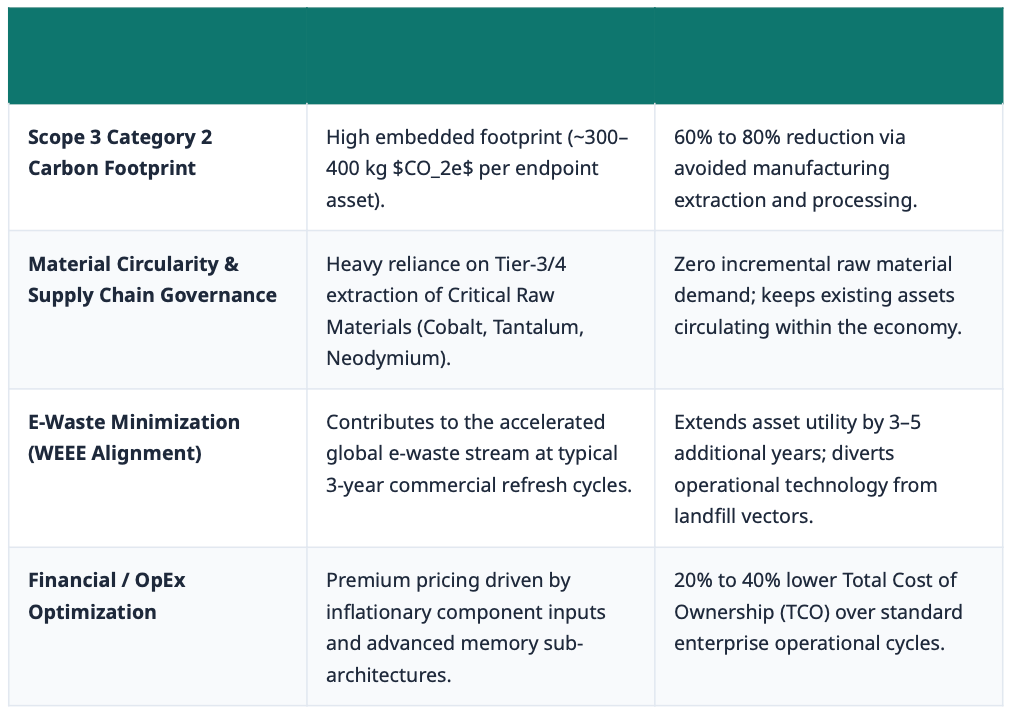
Under standard lifecycle assessment (LCA) methodologies, the environmental burden of digital hardware is heavily front-loaded. Up to 75% to 85% of an enterprise laptop’s lifetime CO2 equivalent ($CO_2e$) footprint is generated exclusively during the extraction, chemical processing, assembly, and global transportation phases before the power button is ever pressed.
By sourcing certified refurbished assets, corporate procurement departments execute a strategy of carbon avoidance. Every additional year a device remains active in an office or server rack prevents new manufacturing footprints from occurring, providing a legitimate and auditable decarbonization signal that stands up to strict CSRD third-party verification.
The Carbon Math of Refurbishment
A standard new enterprise laptop carries an embedded manufacturing footprint of approximately 300 to 400 kg of $CO_2e$. Procuring a certified refurbished or remanufactured equivalent cuts that embedded carbon impact by an estimated 60% to 80%, reducing the device's entry baseline to roughly 60 to 80 kg of $CO_2e$. This immediate reduction directly owers audited Scope 3 disclosures.
3. Regulatory Convergence: ESPR, WEEE, and the Digital Product Passport
The shift toward refurbished assets is reinforced by the Ecodesign for Sustainable Products Regulation (ESPR) and the evolution of the Waste Electrical and Electronic Equipment (WEEE) Directive. The European Commission's circular economy strategy is explicitly designed to dismantle premature hardware obsolescence.
The introduction of the Digital Product Passport (DPP) directly supports the scale of the secondary electronics market. Historically, corporate buyers shied away from refurbished units due to informational deficits regarding component state-of-health, repair history, and material authenticity. The DPP resolves this opacity by providing a decentralized, verifiable history of the device. Consequently, enterprise procurement teams can purchase secondary assets with the same performance guarantees, component traceability, and software security roadmaps traditionally reserved for factory-new devices.
4. Environmental and Social Co-Benefits: Beyond Carbon
While carbon accounting dominates executive attention, the structural value of circular IT hardware spans all three pillars of ESG criteria:
Environmental: Mitigating the Critical Raw Material Crisis
Modern computing hardware requires an intense concentration of Critical Raw Materials (CRMs), including rare-earth magnets, indium for displays, and lithium/cobalt for power systems. Sourcing raw components introduces major environmental hazards, including ecosystem destruction and high water consumption during processing. By utilizing refurbished systems, enterprises limit further degradation and keep critical metals inside the European market, supporting the EU’s push for strategic raw-material autonomy.
Social: Ethical Sourcing and Digital Inclusion
The upstream extraction layer of the electronics supply chain carries significant human rights risks. Moving away from new component procurement reduces an enterprise's direct exposure to unverified mining practices. On a local level, the growth of certified refurbishment hubs creates specialized engineering and technical jobs within the EU, supporting regional employment and fostering social equity through the secondary availability of lower-cost, high-performance computing power.
Governance: Lifecycle Auditing and Asset Disclosure
Partnering with certified refurbishers operating under standards like R2v3, ISO 14001, and e-Stewards provides corporate compliance teams with reliable asset governance. These certifications ensure that software licenses are managed correctly, data erasure protocols meet strict security standards, and end-of-life assets are recycled responsibly, providing clear, auditable documentation for annual ESG statements.
5. The Strategic Action Plan for CIOs and Chief Procurement Officers
Implement Tiered Workplace Allocation: Not every workstation requires bleeding-edge computational power. While specialized development, engineering, or quantitative research roles may require new high-tier hardware configurations, standard operational and administrative roles can be seamlessly serviced by high-grade certified refurbished enterprise laptops, cutting emissions and capital expenditures simultaneously.
Mandate Dual Sourcing in IT Tenders: Corporate procurement policies should be updated to require that all Request for Proposals (RFPs) for hardware provisioning contain a mandatory circular or refurbished option. Bidders must be required to provide verified carbon lifecycle data for both alternatives to allow for empirical ESG and financial trade-off analysis.
Secure Long-Term Circular Partnerships: Enterprises should form strategic alliances with established, certified refurbishing organizations that offer clear warranties and automated data integration. These partnerships ensure a predictable supply of enterprise-grade hardware while providing automated, machine-readable ESG reporting data directly into the corporation's central carbon-accounting software.
6. Conclusion: The Convergence of Purpose and Profit
The integration of refurbished electronic assets into corporate networks represents a mature convergence of commercial pragmatism and regulatory compliance. Under the strict realities of the CSRD and ESPR frameworks, maintaining a purely linear procurement model introduces clear operational friction and inflation risks.
By treating corporate computing hardware as a circulating asset rather than a disposable commodity, European businesses can systematically lower their Scope 3 footprints, strengthen their supply chain resilience, and capture substantial financial savings— proving that real circularity is a distinct competitive advantage.
About the Author: This industrial briefing was compiled by a senior analyst in corporate circular value chains and European ESG policy. The analysis focuses on the technical integration of circular economy principles into corporate governance frameworks and sustainable capital expenditure tracking.