An Integrated Compliance-as-a-Service platform for EU DPP & ESG Reporting (Scope 3 Audit), and Circular Electronic Asset Health Test

What Is a Digital Product Passport (DPP)?
Understanding the future of circular product compliance in Europe.
EU ESG Insights & Regulatory Briefing
SUMMARY
REGULATORY FOUNDATION: Enforced by the Ecodesign for Sustainable Products Regulation (ESPR) under the European Green Deal to eliminate systemic marketplace opacity.
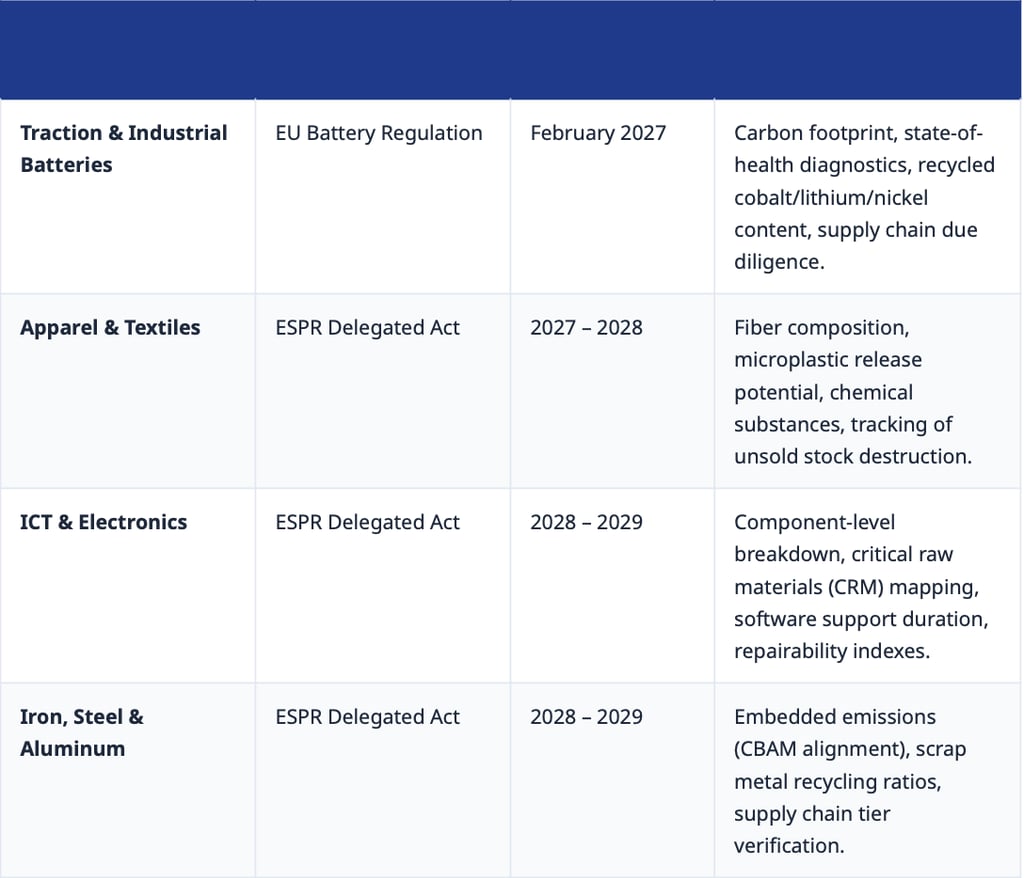
MANDATORY DEADLINES: Phase-1 launches with electric vehicle and industrial battery passports in February 2027, expanding to consumer electronics and ICT infrastructure by 2028-2029.
OPERATIONAL IMPLICATION: Requires hardware OEMs to log granular bill of materials, recycled metal shares, repairability diagrams, and end-of-life recovery parameters directly into decentralized ledgers.
Focus Area: EU ESG Regulation, Ecodesign for Sustainable Products Regulation (ESPR)
Industry Focus: Circular Electronics, Batteries, Information & Communications Technology (ICT)
Publication Date: July 2026
Target Audience: Chief Sustainability Officers, Compliance Directors, Supply Chain Operators, Electronic OEMs
1. Executive Summary
The European Union is fundamentally redefining the relationship between data, commercial responsibility, and product lifecycles. At the vanguard of this shifting regulatory landscape is the Digital Product Passport (DPP)—a mandatory framework introduced under the Ecodesign for Sustainable Products Regulation (ESPR). The DPP represents a structural transformation away from linear, opaque global supply chains toward an institutionalized, data-driven circular economy.
For manufacturers, distributors, and recyclers—particularly within the circular electronics sector—the DPP is not merely an incremental compliance checkbox. It is an operational overhaul that mandates granular component tracking, material verification, and full lifecycle traceability. This briefing unpacks the architecture of the DPP, evaluates the upcoming regulatory timelines, analyzes the profound implications for the electronics sector, and offers an expert strategic roadmap for industrial readiness.
DEFINITION BLOCK
Digital Product Passport (DPP): Under the EU Ecodesign for Sustainable Products Regulation (ESPR), a DPP is a decentralized digital record accessed via a physical data carrier that aggregates verified lifecycle data—encompassing material origin, carbon profiles, repairability guides, and recycling instructions—for assets across European single-market operations.
2. Regulatory Foundation: ESPR and the European Green Deal
The DPP is not a standalone policy directive; it is the operational implementation mechanism of the Ecodesign for Sustainable Products Regulation (ESPR), which entered into force in July 2024 as part of the broader Circular Economy Action Plan under the European Green Deal. The ESPR expands the scope of the legacy 2009 Ecodesign Directive beyond energy-related products to encompass virtually all physical goods placed on the EU market.
The regulatory intent is explicit: to decouple economic growth from resource consumption. By compelling organizations to disclose comprehensive data regarding material composition, carbon footprints, repairability, and end-of-life options, the European Commission aims to eliminate systemic marketplace asymmetric information. Consumers and industrial buyers will gain the capability to make empirically grounded purchasing decisions, while waste management and recycling entities will acquire the technical data required to execute high-fidelity component recovery and material upcycling.
Regulatory Framework Intersection
The DPP directly interfaces with other foundational EU frameworks, including the Corporate Sustainability Due Diligence Directive (CSDDD), the Corporate Sustainability Reporting Directive (CSRD), and the EU Battery Regulation, creating a unified digital web of corporate and product-level accountability.
3. What data fields and metrics are mandatory for an EU Digital Product Passport?
A DPP is essentially a decentralized digital ledger linked to a physical product via a data carrier —such as a QR code, RFID tag, or NFC chip. It provides access to verified data across the product's entire value chain. Crucially, the DPP operates on a permissioned access model: while certain data fields (like basic dimensions, repairability scores, and recycled material percentages) are public, highly proprietary information (such as exact bill of materials, supplier identities, and specific tier-2 sourcing details) is restricted to regulatory auditors, certified repairers, or waste treatment operators.
•Identification and General Tracking: Unique Product Identifiers (UIDs), Global Trade Item Numbers (GTIN), manufacturing location metadata, and importer credentials.
•Material Composition & Circularity: Detailed substance declaration (including Substances of Very High Concern - SVHC), the precise percentage of pre- and post-consumer recycled content, and a complete breakdown of raw materials.
•Performance and Sustainability Metrics: Scope 3 product-level carbon footprint, water consumption data, toxicity profiles, and energy efficiency ratings.
•Repairability, Disassembly, and Remanufacturing: Disassembly manuals, component-level exploding diagrams, wiring schematics, tooling requirements, and software update availability guarantees.
•End-of-Life (EoL) Guidance: Specific treatment instructions, material segregation protocols, and localized collection or take-back scheme information.
4. Sector-Specific Rollout Timelines and Priority Groups
The European Commission is implementing a phased rollout strategy, prioritizing high-impact sectors characterized by high energy intensity, substantial resource consumption, and significant volumes of waste generation.
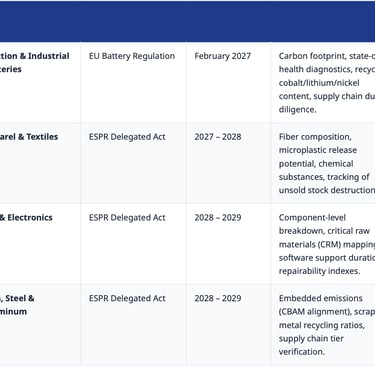
The EU Battery Regulation serves as the immediate pilot pathfinder, with mandatory battery passports taking effect in February 2027 for industrial and electric vehicle (EV) batteries. Under the broader ESPR framework, specific delegated acts for priority product categories are scheduled for enforcement between 2027 and 2030.
5. Deep Dive: Implications for the Circular Electronics Sector
The electronic sector represents one of the most complex domains for DPP execution due to hyper-fragmented global multi-tier supply chains, rapid product obsolescence, and the concentration of Critical Raw Materials (CRMs) such as tantalum, cobalt, neodymium, and indium. The implementation of the DPP will trigger three fundamental disruptions in this sector:
A. The Operationalization of the 'Right to Repair'
Historically, original equipment manufacturers (OEMs) have maintained a monopolistic control over repair ecosystems through proprietary diagnostics, restricted parts availability, and opaque assembly architecture. The DPP dismantling this mechanism by requiring the open disclosure of disassembly paths and diagnostic error codes. This democratizes the independent repair market and extends the primary operational lifespan of laptops, smartphones, and servers, significantly reducing e-waste volumes.
B. Institutionalizing Secondary Material Valuation
A primary barrier to the scaling of circular electronics has been the variable quality and unknown history of secondary raw materials. When a recycler receives an electronic device, identifying the exact grade of flame-retardant plastics or the purity of precious metals inside chips requires destructive testing. The DPP solves this problem. Recyclers can instantly scan a device to ascertain its exact material anatomy, making urban mining economically viable and directly stimulating a highly liquid market for secondary electronics components.
C. Eradicating Supply Chain Opacity
Electronics manufacturers must now trace components down to the mine of origin or the specific chemical processing facility. This requirement intersects directly with the Corporate Sustainability Due Diligence Directive (CSDDD). It means that human rights violations, environmental degradation, or non-compliant mining practices in Tier-3 or Tier-4 suppliers will automatically compromise the product's compliance state, preventing it from legal entry into the European Single Market.
The Commercial Risk of Non-Compliance
Under the ESPR, products that fail to present a valid, verified DPP at the EU border will face immediate market bans, customs impoundment, and severe financial penalties calculated as a percentage of the entity's regional turnover. Compliance is a strict prerequisite for market access.
6. Strategic Roadmap: How Electronics OEMs Must Prepare
Data Governance and Supply Chain Integration: Companies must move past static PDF supplier declarations. OEMs must implement secure, interoperable data architectures—such as decentralized data spaces or distributed ledgers—integrated directly with Supplier Relationship Management (SRM) software. Sourcing contracts must be rewritten to legally oblige suppliers to provide verified, machine-readable material data.
Design for Circularity (Eco-Design Re-engineering): Product development teams must proactively transition to modular product architectures. Fasteners must replace adhesives, components must be standardized, and materials must be selected based on their recycled- content availability and ease of eventual mechanical recycling. If a product is difficult to take apart, its DPP will reveal a poor repairability score, damaging brand equity and increasing regulatory disposal fees (Extended Producer Responsibility - EPR fees).
Business Model Innovation: The DPP provides the exact technical baseline required to shift from traditional transactional sales to Product-as-a-Service (PaaS) and circular lease models. Because the OEM retains ownership and tracks the operational state-of-health via the passport, it can optimize asset collection, refurbishment, and secondary market redistribution, capturing multiple revenue streams from a single physical asset.
7. Conclusion: The Competitive Premium of Compliance
The Digital Product Passport is a massive evolutionary shift in global trade. It represents a transition away from an era of unaccountable production into a new epoch of absolute corporate transparency. While the near-term operational and data engineering hurdles are complex, the long-term strategic dividend is profound.
Forward-looking electronic brands that build deep data competencies, redesign for longevity, and embrace circular traceability will not only insulate themselves from regulatory exposure— they will secure significant competitive premiums in a market increasingly defined by resource scarcity and conscious corporate procurement.
About the Author: This industrial briefing was compiled by a senior researcher in EU Environmental Policy and Sustainable Supply Chain Governance. The analysis draws upon active legislative monitoring of the Ecodesign for Sustainable Products Regulation (ESPR) and strategic consultation within the European circular electronics ecosystem.