An Integrated Compliance-as-a-Service platform for EU DPP & ESG Reporting (Scope 3 Audit), and Circular Electronic Asset Health Test

How Certified Data Wipe Protects Your Business
Why secure IT asset disposal is critical for modern organizations.
EU ESG Insights & Regulatory Briefing
SUMMARY
DATA PRIVACY PENALTIES: Unverified asset disposition directly triggers GDPR data breach protocols, resulting in liability exposure up to €20M or 4% of global turnover.
NIS 2 COMPLIANCE INFRASTRUCTURE: Mandates that corporate boardrooms assume direct personal liability for supply chain physical asset disposal vectors.
THE CIRCULAR SOLUTION: Shift from carbon-intensive hardware shredding to software-driven cryptographic sanitization under NIST SP 800-88 standards.
Focus Area: Data Privacy Compliance, IT Asset Disposition (ITAD), GDPR, NIS 2 Directive
Industry Focus: Enterprise Cyber Security, Corporate Risk Management, Circular Economy Procurement
Publication Date: July 2026
Target Audience: Chief Information Security Officers (CISOs), Data Protection Officers (DPOs), Risk Operations Directors
1. Executive Summary
In an era defined by aggressive cyber threat landscapes and severe regulatory enforcement, the concept of corporate data security has expanded far beyond active
firewalls and perimeter cloud defense. One of the most critical vulnerabilities modern enterprises face lies in the physical disposal and decommissioning of hardware. As organizations cycle through endpoint computers, mobile devices, and data center drives, the residual data remaining on decommissioned hardware represents an immense operational, reputational, and compliance liability.
This briefing explores the role of Certified Data Sanitization within modern IT Asset Disposition (ITAD) frameworks. It provides a strategic analysis of the regulatory consequences under GDPR and NIS 2, evaluates the security flaws of unverified erasure methods, and demonstrates how certified software overwriting serves as the bridge connecting data privacy mandates with circular asset recovery goals.
DEFINITION BLOCK
Data Sanitization (NIST SP 800-88): A technical computing verification sequence that completely purges targeting fields on non-volatile media storage devices, ensuring that recovery of original binary elements is impossible even when attacked by forensic lab utilities.
2. The Regulatory Crucible: GDPR Enforcement and the NIS 2 Imperative
Enterprise oversight during corporate hardware decommissioning is no longer treated as an administrative oversight; it is a major compliance risk under current EU law. The General Data Protection Regulation (GDPR) mandates strict accountability across the entire data lifecycle, including the technical execution of permanent data erasure.
Under GDPR Article 32, organizations are legally required to implement technical measures that guarantee a level of security appropriate to the processing risk. When an asset leaves a facility without verified data destruction, the organization has effectively lost custody of personal identifiable information (PII). This triggers the immediate legal threshold of a corporate data breach, attracting penalties up to €20 million or 4% of total worldwide annual turnover.
The Escalating Threat of NIS 2
The enforcement of the NIS 2 Directive introduces personal administrative liability for corporate leadership teams who fail to manage supply chain and hardware risk profiles. If decommissioned corporate drives end up on secondary markets containing operational data, leadership can face direct personal enforcement actions and corporate suspensions for systemic risk failures.
3. Why does standard disk formatting fail GDPR data compliance audits?
A widespread vulnerability within corporate IT environments is the belief that basic disk formatting or standard factory resets are sufficient for data security. These common methods leave internal organization data completely exposed to basic forensic retrieval tools.
Formatting vs. Sanitization: Standard operating system formatting merely removes the local directory indexes, hiding the file paths while leaving the underlying binary data fully intact on the physical storage media.
The SSD Architecture Challenge: Modern Solid-State Drives (SSDs) utilize advanced wear-leveling algorithms that distribute data across various flash blocks to extend hardware life. Traditional data overwriting patterns often fail to reach these hidden, reallocated sectors, leaving fragments of proprietary code or customer PII accessible to targeted extraction techniques.
True data security requires certified software sanitization. This process utilizes internationally recognized overwrite protocols (such as NIST SP 800-88 Rev. 1 or ADISA standards) to completely replace every storage sector with random, non-functional binary code, permanently destroying the original records while keeping the underlying physical drive functional for future use.
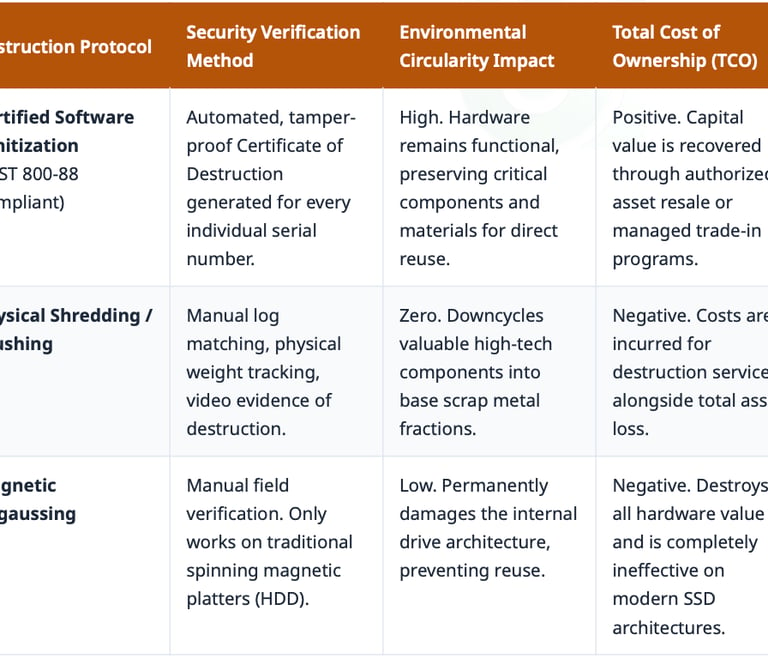
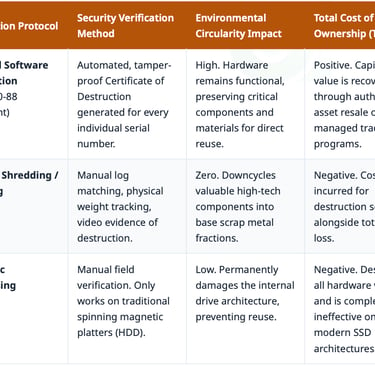
4. Certified Wipe vs. Physical Destruction: The Sustainability Paradox
Historically, risk-averse Chief Information Security Officers (CISOs) defaulted to the physical destruction of drives—using industrial shredding or degaussing—to minimize data risk. However, this approach directly contradicts corporate ESG strategies and upcoming circularity mandates under the Ecodesign for Sustainable Products Regulation (ESPR).
Shredding valuable corporate IT assets destroys the intrinsic economic and functional value of the equipment, forcing the organization to absorb high replacement costs and creating unnecessary e-waste. Certified data wiping solves this conflict by providing full security compliance while allowing hardware to be safely reused or resold on secondary markets.
5. The Strategic Action Plan for CIOs and Chief Procurement Officers
To defend against data leakage and satisfy external regulatory auditors, corporate leadership must implement an auditable, chain-of-custody data sanitization framework across three operational vectors:
Enforce Stringent Chain-of-Custody Controls: The risk window opens wide during the collection and transport of assets between active office space and processing hubs. Organizations must mandate secure collection bins, tracked logistics vehicles, and immediate serial-number logging upon arrival at the processing partner's facility.
Mandate Tamper-Proof, Serialized Certificates: Never accept generic invoices as proof of data destruction. A secure ITAD process requires an immutable, software-generated Certificate of Destruction for every unique storage device asset serial number, providing the clear auditable documentation required by external data protection authorities.
Verify Downstream Recycling Standards: If an asset cannot be reused due to component degradation, ensure your processing vendor uses certified e-waste facilities that handle the final physical recycling according to local environmental rules (such as WEEE standards).
6. Conclusion: Security as an Enabler of the Circular Economy
Corporate risk mitigation and sustainable business practices are often viewed as conflicting goals. However, certified data wiping demonstrates how technical compliance can actively support corporate sustainability targets.
By moving from destructive shredding policies to verified data sanitization frameworks, modern organizations can build reliable lines of data defense, protect themselves from significant regulatory fines, and unlock the clear financial value of secondary electronics markets—turning a traditional compliance cost center into a transparent strategic asset.
About the Author: This corporate security briefing was compiled by a senior policy analyst specializing in data privacy governance and enterprise IT Asset Disposition (ITAD) frameworks within the European Union market.