An Integrated Compliance-as-a-Service platform for EU DPP & ESG Reporting (Scope 3 Audit), and Circular Electronic Asset Health Test

Why a Circular Asset Health Test Is Mandatory
Understanding the future of circular product compliance in Europe.
EU ESG Insights & Regulatory Briefing
SUMMARY
MARKET TRUST MECHANISM: Replaces qualitative, manual asset visual grading profiles with programmatic hardware metrics linked straight to the product's digital record.
ANTI-DOWNCYCLING CONTROLS: Directly addresses the "Market for Lemons" structural barrier that blocks large organizations from procuring used IT hardware.
FINANCIAL INCENTIVE MODELS: Syncs directly with upcoming EU Extended Producer Responsibility (EPR) programs to reduce raw tax liability for highly durable designs.
Focus Area: Ecodesign for Sustainable Products Regulation (ESPR), Product Passport Diagnostics, Lifecycle Metrics
Industry Focus: Circular Electronics, ITAD Operations, OEM Manufacturing, Asset Life Optimization
Publication Date: July 2026
Target Audience: Chief Sustainability Officers, Technical Compliance Directors, Asset Managers, ITAD Auditors
1. Executive Summary
The commercial expansion of the European circular economy relies heavily on verified information transparency. As the Ecodesign for Sustainable Products Regulation (ESPR) makes the Digital Product Passport (DPP) mandatory across key industrial sectors, market actors require empirical, standardized methods to evaluate the actual wear and performance status of products. The Circular Asset Health Test has emerged as a fundamental operational mechanism to address this need.
Moving far beyond simple structural inspections, a Circular Asset Health Test uses algorithmic hardware diagnostics, firmware log verification, and capacity degradation measurements to provide a standardized score of an asset's functional capability. This briefing examines the operational reasons why these health tests are necessary to eliminate transaction uncertainty, reduce early recycling volumes, and protect financial margins in secondary consumer and industrial markets.
DEFINITION BLOCK
Circular Asset Health Test: An algorithmic validation methodology that interrogates firmware metrics (such as battery internal impedance matrices or logic sector failure configurations) to dynamically define an equipment's structural degradation index.
2. Eliminating Lemons: The Lemons Problem in Secondary
The primary obstacle blocking corporate procurement teams from buying secondary IT assets or remarketed industrial systems is the economic concept known as the Information Asymmetry Trap (Akerlof’s "Market for Lemons"). Without an objective, third-party method to confirm the internal condition of an asset's battery cell, logic board, or storage cache, buyers naturally assume hidden defects exist. This structural uncertainty depresses asset values and forces risk-averse organizations to purchase factory-new equipment instead.
A formalized Circular Asset Health Test resolves this market friction. By providing an objective, machine-readable breakdown of the asset's current performance status directly to the Digital Product Passport infrastructure, the health test turns unknown performance risks into verified operational metrics. Buyers can instantly confirm the asset's remaining utility, unlocking institutional liquidity for refurbished enterprise platforms.
The Value-Gap Resolution
A corporate notebook returning from a 3-year commercial lease holds an ambiguous valuation without verification. Conducting a certified asset health test that confirms a 92% lithium-ion capacity retention, zero bad storage blocks, and pristine logic gates increases the asset's secondary market value by up to 35% compared to unverified batches.
3. Mitigating Premature Recycling Vectors
Within traditional, linear waste-management frameworks, thousands of tons of high-performance electronic components are directed into shredding and raw material melting lines every day. While mechanical recycling recovers raw copper, gold, and aluminum, it constitutes a significant downcycling event that destroys the original engineering value of the assembly.
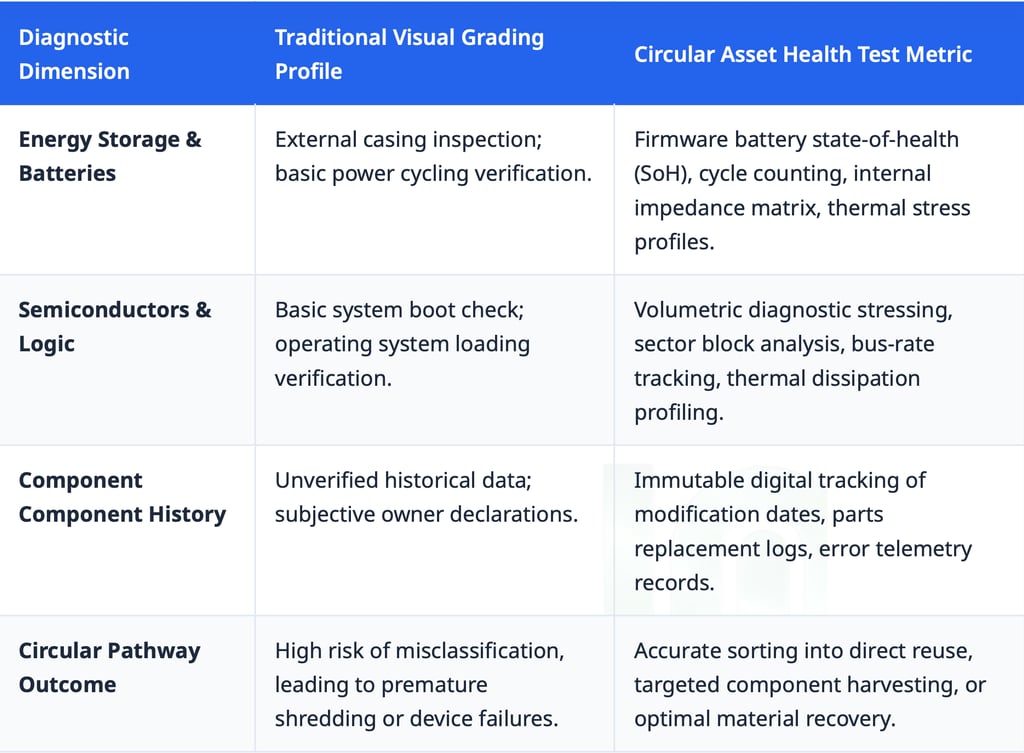
A primary driver for mandatory health testing under upcoming ESPR delegated acts is the prevention of this premature recycling. By requiring a standardized diagnostics assessment before an asset can be legally classified as electronic waste, regulations ensure that components with high remaining utility scores are routed to repair and refurbishment streams instead. This systematic approach preserves the high-value engineering steps invested during initial manufacturing, significantly lowering global scope 3 carbon metrics.secondary assets with the same performance guarantees, component traceability, and software security roadmaps traditionally reserved for factory-new devices.
4. The Technical Blueprint of an Asset Health Framework
A reliable, audit-ready Circular Asset Health Test must cover three key technical diagnostic layers to ensure accurate marketplace data:
Structural Degradation Analysis: Deep technical probing of components prone to degradation, such as battery chemistry wear levels, flash cell depletion rates, and fan speed variances under workload.
Telemetry and Error Diagnostics: Automated extraction of internal system alerts, memory parity failures, and thermal limit events recorded during the product's operational cycle.
Functional Capability Benchmarking: Running standardized performance benchmarks to compare current device throughput against original factory-fresh metrics, establishing a clear percentage performance baseline.
5. Integration with Extended Producer Responsibility (EPR) Pricing
The strategic deployment of asset health tests intersects directly with the modern restructuring of Extended Producer Responsibility (EPR) eco-modulation fees across the European Union. Under new circular economy rules, manufacturers are penalized or rewarded based on the true circular performance of their products.
Products built with modular architectures that achieve high health scores after years of active deployment will qualify for lower EPR fee rates. By linking the digital record of the asset health test directly to the manufacturer's regulatory account, the EU provides a strong financial incentive for brands to design for longevity, modular repairability, and long-term performance retention.
6. Conclusion: Establishing the Core Metric of Circularity
The circular economy cannot scale effectively on good intentions alone; it requires precise, verifiable technical data. The Circular Asset Health Test provides the objective verification layer that transforms used equipment into transparent, dependable commodities.
As European compliance mandates tighten through the ESPR and Digital Product Passports, the ability to test, score, and certify the health of physical assets will become a standard operational requirement—protecting buyers, raising secondary market values, and maximizing the lifetime utility of industrial assets.
About the Author: This compliance analysis was compiled by an expert researcher in sustainable diagnostic design and European circular product policy, tracking the evolution of data integration frameworks under the ESPR.
Contact DPPNexus:
Email: info@dppnextus.com
© 2026 DPPNexus ApS. All rights reserved.
Get in Touch
CVR. 46301331